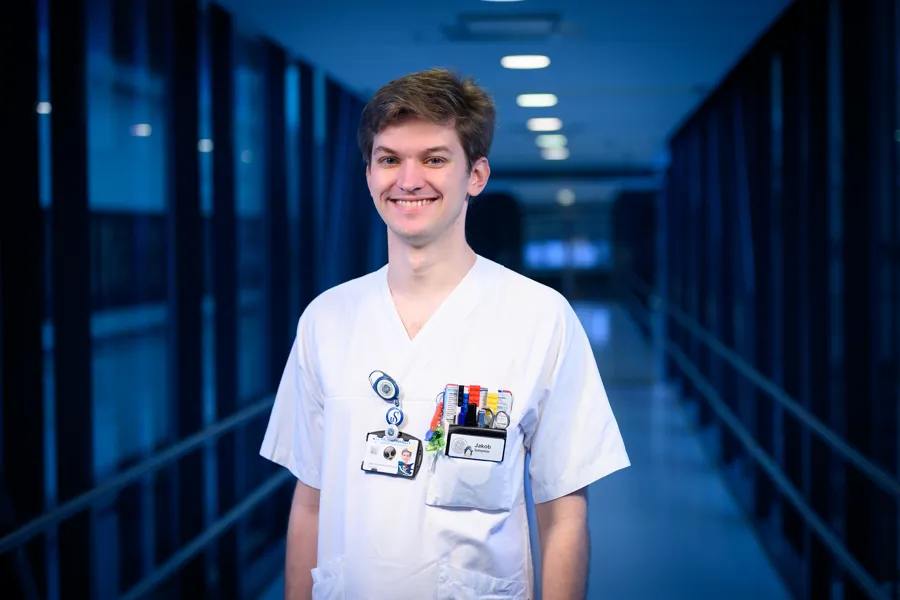
Would you like to know more about the trainee program?
Read the interview in Sykepleien with former trainee nurse Jakob Hammelsund Grung.
We have trainee positions for nurses in several of our clinics. The program provides newly graduated nurses and nurses with a maximum of two years of experience with a broad knowledge base and insight into various departments.
A trainee position is a 100% permanent position with a three-part shift schedule. The position is for you who are a newly graduated nurse or have less than two years of work experience as a nurse.
The trainee program lasts for 24 months and includes rotation between departments/outpatient clinics every 4–6 months. You will always receive training when starting in a new department or outpatient clinic.
As a trainee nurse, you will receive regular follow-up through conversations with clinic or department management every 6–8 weeks. Additionally, you will receive group guidance at least every three weeks together with other trainee nurses and nurses.
Trainee nurses have the same salary conditions as other nurses, are part of the regular staffing, and participate in the normal activities of the department. This also means that you participate in the department's regular training and internal education.
After completing the program, the permanent position continues in the department/clinic where you are employed. Here, you can also express your preferences.
Trainee positions are advertised in our recruitment system, Webcruiter, every year in December. Go to Webcruiter
The Staffing Center is a separate department at SUS. The Staffing Center collaborates with all clinics that have a trainee program. With us, you will have the opportunity to work in at least three different clinics, both in somatics and psychiatry.
Departments included in the Staffing Center for the trainee program are
Through a trainee position, you will gain broad nursing experience and the opportunity to develop the ability to work both independently and interdisciplinary. Working across different clinics will provide unique knowledge and understanding of various aspects of the hospital's operations and organization. This experience will be very useful in meeting the future need for flexible and varied competence.
The Intensive Care Unit at Stavanger University Hospital offers a trainee program for nurses. The goal of the program is to ensure that newly hired nurses in the Intensive Care Unit gain knowledge, professional competence, and the ability to monitor postoperative patients and stable intensive care patients.
The program is relevant for nurses, preferably with hospital experience, who wish to work with postoperative and intensive care patients, and who may eventually consider pursuing a master's degree/continuing education in intensive care nursing. You must be eager to learn, professionally engaged, and motivated for varied work experience.
You will be employed in a 100% permanent position in the Intensive Care Unit, with a 6-month probation period. After completing training in the department's 3 units, you will rotate working in the various units.
The department heads in the Intensive Care Unit are responsible for the trainee nurses. You will be assigned a manager at the start of the trainee program. Daily follow-up, work schedules, absence, and long-term absence will be managed by the manager.
The trainee positions are advertised twice a year. There is a common start date in the Intensive Care Unit in January and September. Interviews and reference checks take place after the application deadlines, and we send out job offers continuously. We hire up to 6 trainee nurses each semester.
The University of Stavanger offers a master's program in intensive care nursing with annual admissions. The application deadline is in early February.
Upon confirmation of a study place, trainee nurses can apply for an educational position at SUS. The agreement applies to a permanent position at SUS consisting of a 100% educational position during the study period (up to 90 credits), with a binding period of 3 years in a 100% position. In an educational position, you will receive 90% of the minimum wage as a nurse based on credited seniority. During this period, you will also work in a 10% weekend position and 4 weeks in the summer in a 100% position. For this, you will receive regular pay as a nurse.
Magritt Fraser Wareng, department head. Phone: 48 07 74 75
Gunhild Bakkalia Bjørnå, nursing professional advisor. Phone: 99 44 08 35
Departments with trainee positions:
Treats patients with diseases in the gastrointestinal region. A large portion of the patients in 6G have a cancer diagnosis. The department has high competence in cancer care and cancer pathways. In 6H, many patients have a cancer diagnosis and/or are stoma-operated. The department has high competence in cancer care and stoma. Gastro has a stoma outpatient clinic and has its own stoma nurses.
Offers examination, treatment, surgery, and follow-up of patients with urological disorders (surgical disorders of the urinary tract).
A surgical ward that investigates and treats disorders in blood vessels and thorax (blood vessels and lungs). The ward has wound care nurses and good competence in thoracic drains. 4E is a trauma ward. The vascular/thoracic outpatient clinic is located in connection with the ward.
Has extensive collaboration with the urology ward. The urology outpatient clinic's main task is to offer investigation, diagnosis, treatment, and follow-up of patients with urological disorders. The work at the department is carried out by doctors, urotherapists, nurses, nursing assistants, and secretaries in an interdisciplinary collaboration.
An outpatient clinic with day surgery. The patient group has benign or malignant disorders in the breast, and disorders in the thyroid and parathyroid glands. The outpatient clinic performs day surgical procedures for breast cancer and neck procedures, as well as follow-up before and after surgery. Additionally, outpatient controls are conducted.
Has the country's largest laser section (laser and IPL) and its own dermatological surgical section. Has high competence in allergy investigation and treatment. Own allergy outpatient clinic, and also specializes in venereal diseases. Is the largest in the country for biological treatment of psoriasis. Also has a mobile wound team that travels to patients for wound care and training of nurses in municipal health services.
Has patients who have undergone prosthetic surgery in the knee and hip joints, and spinal patients. 5E has its own outpatient clinic for control and follow-up of patients who have received prostheses in hips or knees.
Has patients across a wide range of orthopedic areas: pediatric orthopedics, traumatology, foot surgery, arthroscopy, wounds, and infections. Additionally, the department has eight beds for patients needing gastrointestinal surgery.
Has patients from five different specialties: ear-nose-throat, plastic, endocrine, eye, and oral surgery.
Has round-the-clock readiness for patients with head and neck injuries, patients who are to be operated on for brain hemorrhages, and patients with neck and back disorders.
The department consists of a monitoring room for patients who need continuous monitoring after surgery, trauma, or unclear/unstable neurological conditions such as stroke, head injuries, spinal cord injuries, or epilepsy.
Treats patients with diseases of the brain and spinal cord, including epilepsy, headaches, MS, brain tumors, Parkinson's, and ALS. We have close collaboration with therapists and doctors. Common examinations our patients undergo include MRI, CT, spinal puncture, EEG, and EMG.
Provides acute treatment and early rehabilitation of patients with strokes and transient ischemic attacks (TIA). In the stroke unit, the causes of the stroke are investigated, and patients receive early rehabilitation from an interdisciplinary team. The team consists of stroke doctors, specialized nurses, and therapists (physiotherapy, occupational therapy, speech therapy, nutritionists, social workers).
Has a target group where patients primarily need specialized rehabilitation in the hospital, including strokes, head injuries, brain tumors, multiple traumas, complicated orthopedics, and neurological diseases.
The section has 15 inpatient places. Most patients are transferred directly from clinical departments to early complex rehabilitation after the acute phase. Patients needing specialized rehabilitation in the late phase can be referred for primary rehabilitation stays.
Read more about the clinic for surgery, neurology, and rehabilitation
Departments that have trainee positions:
Here you will gain good experience in caring for patients with COPD, asthma, and cancer.
Here you will meet patients with, for example, kidney failure, diabetes, and arthritis.
Has patients with all types of infections, and you will gain good knowledge of infectious diseases and sepsis. You will be well trained in various infection control measures and handling of antibiotics. During your time in the infectious department, you will also have the opportunity to work in the isolation ward 2I.
Here you will gain insight into the complex picture of the sick elderly patient and the interdisciplinary approach that forms the basis for collaboration in the ward.
Here you will gain experience with all types of gastrointestinal diseases that require medical treatment. You will also develop practical skills in nursing patients with bleeding and acute abdominal conditions.
Here you will meet patients who are admitted as emergencies due to chest pain, dyspnea, arrhythmias, or syncope. Elective patients are admitted for, among other things, coronary investigation, PCI, or pacemaker treatment.
Here you will get to know patients who are being investigated for cancer or other serious illnesses. We are responsible for the treatment and follow-up of endocrinological patients, including training and information for patients with newly diagnosed diabetes.
The trainee nurse will gain work experience in various wards and outpatient clinics in the department of blood and cancer diseases during the program.
The work experience and tasks in the trainee nurse program at ABK contribute to increased nursing competence in several ways. Firstly, each nurse employed in a trainee position gains enhanced skills in key areas of cancer nursing.
In all our units, you will encounter patients at different stages of serious illness. Patients may be undergoing investigation, receiving curative or palliative medication-based cancer treatment, radiation therapy, or palliative care. This means we often have to deal with people in crisis, both patients and their relatives. Our goal is to provide holistic nursing and deliver the best possible treatment, care, and support for our patients. We collaborate across disciplines with doctors, nutritionists, physiotherapists, chaplains, social workers, and a mobile palliative team. Additionally, we have extensive cooperation with municipal health services.
2K investigates and treats patients with benign or malignant blood diseases (such as leukemia, myeloma, myelodysplasia) and lymphoma. The ward also treats patients with bowel cancer. We primarily provide medical cancer treatment, supportive care during the aplastic phase, and palliative care.
The ward has patients undergoing investigation and treatment for cancer at various stages. Our main tasks are to provide medical cancer treatment (radiation therapy, chemotherapy, immunotherapy, targeted cancer therapy, and other medications), as well as palliative care. Our largest diagnostic groups are breast, prostate, gastrointestinal, and melanoma cancers.
The ward offers palliative care to patients with severe, life-limiting illnesses and high symptom burdens. Admission to the palliative ward is planned and should be targeted. We work with specialized palliative care, and the purpose of admission is to alleviate distressing symptoms, contribute to safety, coping, and good quality of life in collaboration with the patient and their relatives. We work interdisciplinary and aim to ensure safe and good discharges to the municipality, while also facilitating a dignified and pleasant end for the patient and their relatives in the department.
The outpatient clinic's main task is to provide medical cancer treatment to oncology patients at all stages of the disease. Patients receive treatment during the day, including chemotherapy, immunotherapy, oral medication, and other drugs. Our largest diagnostic groups are breast cancer, prostate cancer, melanoma, and cancers of the gastrointestinal tract. We are committed to ensuring that patients are cared for in a holistic manner and have close collaboration with the wards.
Overall, this provides broad competence and experience that will be useful regardless of where you later work, and it transfers valuable skills between the wards. Another important effect of the trainee program is that you see how the different wards function, what works well, what works less well, and can ask questions about this and make suggestions for professional improvements. Trainee nurses bring their experiences to the next ward and become important contributors to initiating new and improved work processes in the wards. Trainee nurses can provide valuable and constructive feedback on the work environment, thereby helping to highlight and address important issues. This has a positive effect on the work environment in the various wards and fosters development.
In the role of trainee nurse, you will also be asked to be a practice supervisor for nursing students.
The clinic consists of four district psychiatric centers (DPS) located in Stavanger, Sandnes, Sola, and Dalane, in addition to departments for acute, affective, and psychotic psychiatry, as well as geriatric and forensic psychiatry. These departments are situated on the hospital grounds at Våland.
We accept patients with all types of mental disorders. The patients admitted to us are in various phases of their illness.
To ensure that the patient admitted to us experiences the most holistic treatment process possible, we emphasize collaboration across professions and roles. As a trainee, you will gain experience working primarily with social educators and healthcare workers, psychologists/clinical psychologists, psychiatrists, and doctors in training, and in some places, also social workers. This will help you become aware of the nurse's role in interacting with patients admitted to the inpatient wards and with the patients' relatives.
Here you will gain experience in assessment and nursing for individuals with first-episode psychosis.
Here you will gain experience in assessment and nursing for individuals with first-episode affective disorders.
Here you will gain experience in nursing for individuals who are admitted acutely. Some of these are admitted to DPS or wards at Våland, while others are primarily discharged for follow-up outside the hospital.
Here you will gain experience in nursing for individuals who require acute or planned admission. You will also gain insight into collaboration with municipal health services.
Here you will gain experience in assessment and nursing for individuals with issues that are often a combination of geriatrics and severe mental illness.
Here you will gain experience in nursing for individuals who need a shorter admission before moving on to the appropriate level of treatment. The variation in the relevant disorders is significant.
We provide specialized health services to children, adolescents, and young adults in South Rogaland. The clinic consists of four departments, each with several units. Many of the units are located outside the hospital in Våland.
The department has eight units divided into inpatient and outpatient clinics, offering differentiated services to various target groups. ARA provides specialized assessment, treatment, and rehabilitation services for youth aged 15–30+ and their relatives/social networks. Most of ARA's units are located outside Våland.
The department has three inpatient wards in Våland for children and adolescents: one ward that assesses and treats children aged 0 to 13 years and their families/guardians, and two wards that treat adolescents aged 13–18 years who require acute admissions. The department also has seven outpatient clinics for children and adolescents, a specialized outpatient clinic, and one acute mobile youth team.
The Department for Young Adults and Refugees provides differentiated and specialized treatment and rehabilitation services to traumatized asylum seekers and refugees. Additionally, the department offers a wide range of consultation, guidance, and teaching services. AUVF operates on the principle of early intervention and has close collaboration with the psychosis project TIPS and other units at the hospital. The department has two inpatient units, one outpatient clinic, a transcultural center, and school and job prescriptions. All these units are located outside Våland.
Read more about the clinic for mental health care for children, youth, and substance abusers
Kristine Anette Svarstad Forgaard, Specialist Nurse/First Consultant, Staffing Center
Phone: 90 15 67 67
Yvonne Sandanger, Department Nurse, Children and Youth Ward 3E4D
Phone: 95 11 14 43
Jon Vidar Strømstad, Environmental Therapy Advisor, Adult Mental Health Clinic
Phone: 41 32 18 83