Study design
PBCB has recruited 1,455 patients who were treated for breast cancer at Helse Bergen or Helse Stavanger from 2011 to 2019. The patients are followed for 11 years after inclusion in the study with annual (HUS) and semi-annual (SUS) data collection.
To participate in the PBCB study, patients must meet the following criteria:
Inclusion criteria:
- Women who are preoperatively diagnosed with breast cancer
- Must be 18 years of age or older
Exclusion criteria:
- Patients who have had cancer previously
- Under 18 years of age
- Patients who are unable to complete Norwegian questionnaires
From all the 1,455 patients included in the PBCB study, blood and urine samples are collected annually. At Stavanger University Hospital (SUH), blood and urine samples are also collected semi-annually. The following samples are taken during the patient visits:
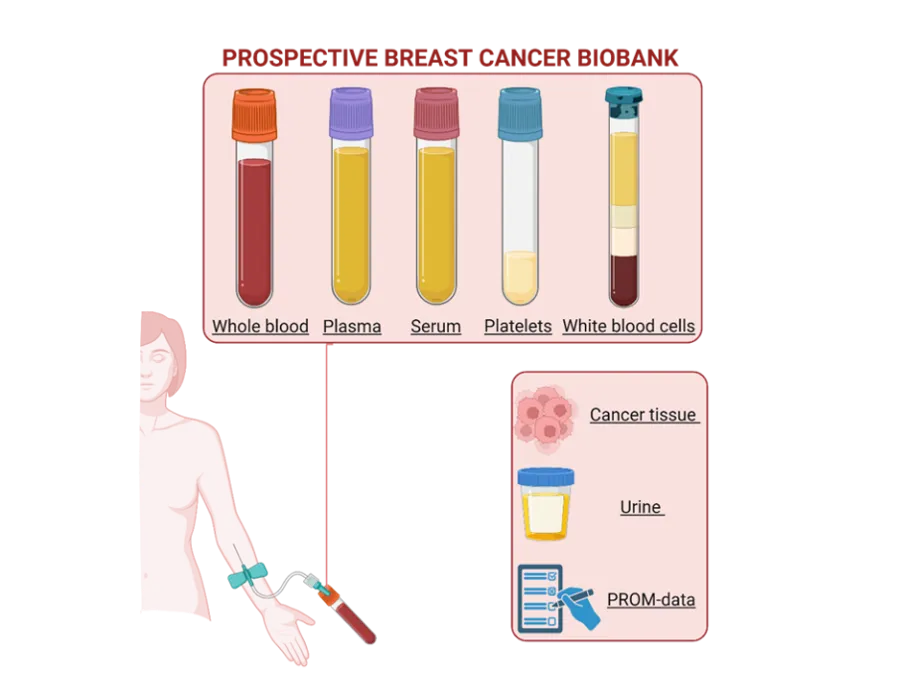
All blood samples collected are processed and stored in different fractions, including whole blood, plasma (warm and cold), serum, platelets, and buffy coat (white blood cells). The table below shows the processing of blood and urine samples, as well as the number of tubes available in the PBCB biobank from each patient at Haukeland and Stavanger University Hospitals.
The number of tubes available in the PBCB biobank from each patient at Haukeland University Hospital:
|
Type of tubes |
Number of tubes |
Respite |
Centrifugation |
Alliquotation |
Volume to be distributed |
Storage |
|
Vacuette Serum without gel, 6 mL |
8 |
30-120 min |
2200xg for 10 min at RT |
8 x 0,7 mL |
525 uL serum |
-80°C |
|
4 x 1,0 mL |
865 uL serum |
|||||
|
Vacuette EDTA, 3 mL
|
1 |
|
|
2 x 1,0 mL |
865 uL full blood |
|
|
Vacuette EDTA, 6 mL |
5 |
Max 2 hours |
2200xg for 10 min at RT |
6 x 0,7 mL |
525 uL plasma |
|
|
2 x 1,0 mL |
864 uL plasma |
|||||
|
2 x 2,0 mL |
1800 uL plasma |
|||||
|
1 x 1,0 mL
|
865 uL buffycoat |
|||||
|
PAXgene, 2,5 mL |
1 |
3-72 hours at RT |
|
|
|
Intermediate storage at -20°C for 24 hours, then -80°C. |
|
Urine, 20 mL |
1 |
|
|
5 x 2 mL |
1800 uL urine |
-80°C |
The number of tubes available in the PBCB biobank from each patient at Stavanger University Hospital:
|
Type of tubes |
Number of tubes |
Respite |
Centrifugation |
Alliquotation |
Volume to be distributed |
Storage |
|
Vacuette Serum without gel, 10 mL |
2 |
30-120 min |
1500xg for 25 min at RT |
6 x 0,5 mL |
3 mL serum |
-80°C |
|
4 x 2 mL |
6 mL serum |
|||||
|
Vacuette EDTA, 6 mL
|
1 |
|
|
2 x 2 mL |
3 mL fullblood |
|
|
Vacuette EDTA, 9 mL |
5 |
Max 2 hours |
2 tubes, 2200xg for 10 min at RT |
6 x 2 mL |
12 mL plasma (warm) |
|
|
1 tube (on ice), 2500 xg at 4°C |
6 x 0,5 mL |
3 mL plasma (cold) |
||||
|
2 x 1 mL |
2 mL plasma (cold) |
|||||
|
1 x 0,5 mL |
0,5 mL buffycoat |
|||||
|
1 tube (on ice), i.) 200xg for 20 min without brake at 4°C, ii.) 200xg for 10 min without brake at 4°C, iii)1000xg for 10 min at 4°C |
1 x 0,5 mL |
0,5 mL blood platelets |
||||
|
CPT, 8 mL |
1 |
|
i) 1500 xg for 25 min at RT ii) 1000xg for 10 min |
|
|
|
|
PAXgene, 2,5 mL |
1 |
3-72 hours at RT |
|
|
|
Intermediate storage at -20°C for 24 hours, then -80°C. |
|
Urine, 20 mL |
1 |
|
|
6 x 2 mL |
9 mL urine |
-80°C |